For tens of thousands of years, before screens and streetlights, the night sky was humanity's television, calendar, compass, and storybook all at once. Every culture on Earth looked up at the same scattering of stars and connected the dots into pictures — a hunter, a bear, a scorpion, a swan. Those pictures are constellations: not real groupings in space, but sticky-notes our ancestors left on the sky to remember the seasons and find their way. Tonight, you can read the very same notes they did.
Where we are on the map
You › Earth › Solar System › Milky Way › Local Group › Observable Universe
Last time: we learned that all this light is old — to look out is to look back in time. Now let's learn to actually find things in that sky.
What you'll be able to do
By the end of this lesson, you'll be able to:
- Tell the difference between a planet and a star with your naked eye.
- Explain what a constellation really is (and isn't).
- Recognize a few signpost patterns to navigate the night sky.
- Explain why the Milky Way appears as a faint band across the sky.
The big picture
Here's the good news before we start: you already own the only equipment you need — your eyes. On a clear, dark night, far from city lights, you can see a few thousand stars, five planets, the Moon, the occasional meteor, and a softly glowing band stretching across the whole sky. Every one of those points of light is a story this course will tell. This lesson is about learning to read the map so that, for the rest of the journey, you can step outside and point to what we're talking about.
And almost everything in that sky is one of two kinds of thing: stars, which are distant suns making their own light, or planets, which are nearby worlds merely reflecting our Sun's light. Telling them apart is the first skill of every skywatcher — and it's surprisingly easy once you know the trick.
The details
The trick: planets shine steadily, stars twinkle
Look up on a clear night and you'll notice that most points of light flicker and shimmer — they twinkle. But a few of the brightest "stars" shine with a steady, calm light and don't twinkle at all. Those steady ones are usually planets.
Why the difference? It comes down to size in the sky. A star is so unimaginably far away that, even through a telescope, it stays an infinitely tiny pinprick of light. When that single pinprick passes through Earth's turbulent, shifting atmosphere (think of the wavering you see above a hot road), the air can wobble all of it at once — so the star appears to twinkle. A planet is millions of times closer, so it shows up not as a pinprick but as a tiny disk — like a small coin instead of a single dot. The air still wobbles it, but the wobbles across its little face cancel each other out, so the planet shines steadily.
The rule of thumb: stars twinkle. Planets don't. If a brilliant "star" is glowing with a steady, slightly creamy or colored light — especially near the horizon after sunset or before sunrise — you're almost certainly looking at a planet.
The five planets visible without a telescope are Mercury, Venus, Mars, Jupiter, and Saturn. Two are showstoppers: Venus, the dazzling "Evening Star" or "Morning Star," is the brightest point of light in the entire night sky after the Moon. Mars is unmistakable for its rusty, orange-red tint. (The other planets, Uranus and Neptune, are too faint to see without binoculars or a telescope.)
What a constellation really is
Point to the constellation Orion and you're pointing at stars that look neighborly — but it's a cosmic illusion. The stars in any constellation are usually nowhere near each other in space; they just happen to fall roughly along the same line of sight from Earth. One might be 500 light-years away, the next 1,500, lined up by pure chance like two streetlights, one down the block and one across town, that appear side-by-side from where you stand.
So a constellation isn't a real object — it's a pattern we project onto the sky, a mnemonic. Astronomers still use them, though: the sky is officially divided into 88 constellations that act like countries on a map, so anyone can say "that comet appeared in Leo" and everyone knows where to look.
A few are worth knowing because they're signposts to everything else:
- The Big Dipper (part of Ursa Major, the Great Bear) — the famous "saucepan" shape. The two stars at the end of its "bowl" point straight to Polaris, the North Star, which sits almost exactly above Earth's North Pole and barely moves all night. Find Polaris and you've found north.
- Orion the Hunter — dominates winter evenings in the Northern Hemisphere (summer in the Southern). Look for the unmistakable three stars in a short, straight row: Orion's Belt.
- The Southern Cross (Crux) — for those south of the equator, this compact cross is the signpost that helps point toward the south celestial pole.
Why the Milky Way is a band across the sky
On a truly dark night, you'll see a pale, milky river of light arching across the whole sky. That faint glow is the combined light of hundreds of billions of stars — it's our own galaxy, the Milky Way, seen from the inside.
Here's the key idea. Our galaxy is shaped roughly like a flat disk — picture a fried egg, or two dinner plates stuck rim to rim, with a bulge in the middle. And we live inside that disk, a little over halfway out from the center. So when you look along the plane of the disk, your line of sight plows through layer after layer of distant stars, far too many and too far to see individually — they blur into a glowing band. When you look above or below the disk, you're staring out the flat face into near-emptiness, and the sky looks darker. That's the whole trick: the "band" is just the long way through our own pancake-shaped city of stars.
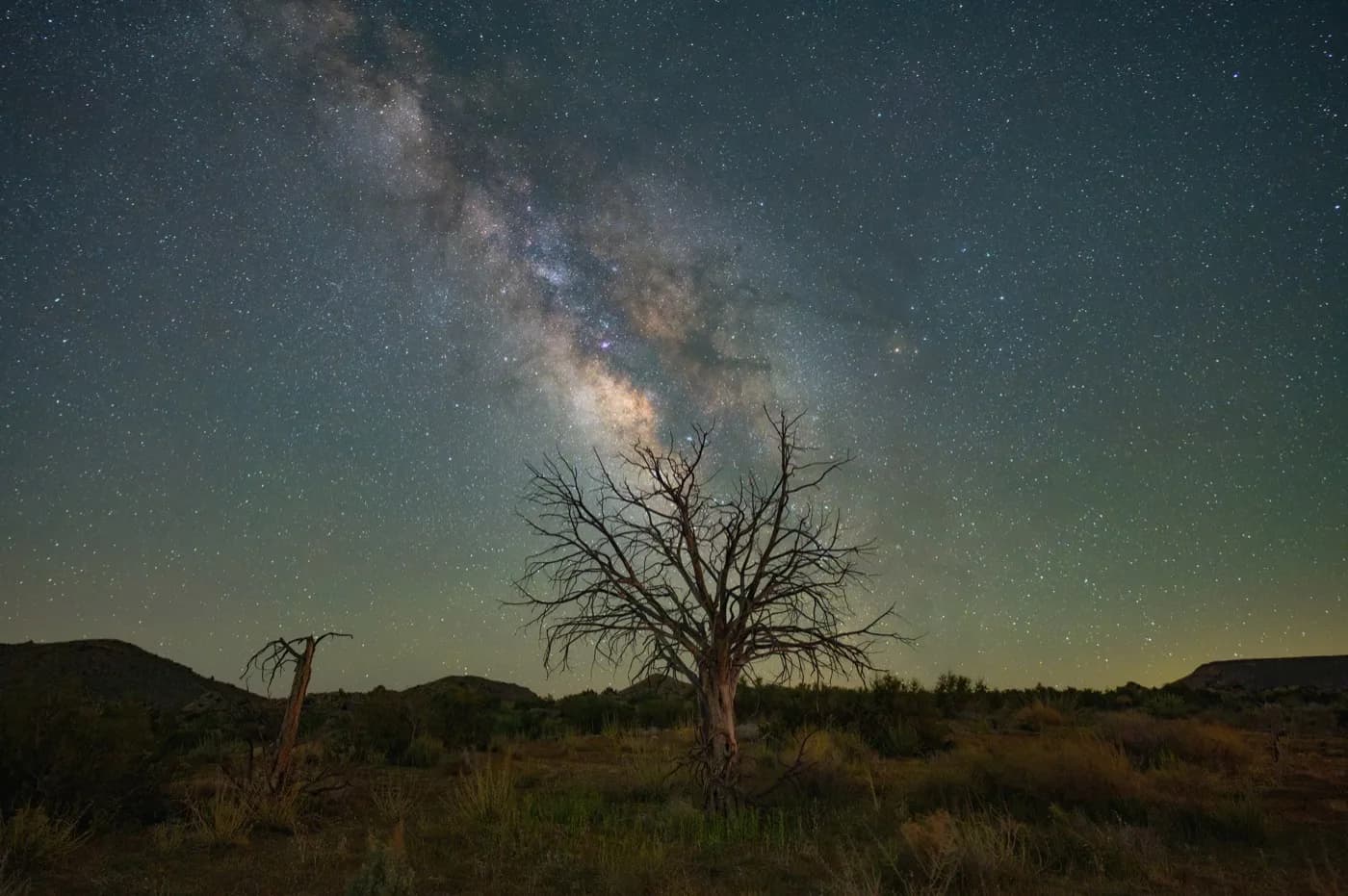
Image credit: NASA/Preston Dyches. Original image and NASA credit.
We'll come back and map this whole galaxy from the inside in Module 6. For now, just know: that ghostly band has a name, and it's home.
Analogy box: why is it called the Milky Way?
To the naked eye it genuinely looks like someone spilled a splash of milk across the black sky — a soft, hazy smear, not individual stars. The ancient Greeks thought it looked like a stream of milk (galaxías kýklos, "milky circle" — the root of the very word galaxy). Only in 1610, when Galileo pointed his new telescope at it, did anyone discover the "milk" is actually countless individual stars, too faint and crowded to separate by eye. The smear resolved into a swarm. We'll meet Galileo properly in Module 3.
Math spotlight OptionalSkip without losing the story
No math this lesson — just wonder, and a sky to go look at.
(If your number-loving brain is itching: hold tight. Lesson 4 is where we put cosmic distances on a scale you can feel.)
Meet the people and missions
Long before telescopes, whole civilizations were master skywatchers out of necessity. The Polynesian navigators crossed thousands of kilometers of open Pacific Ocean — with no instruments at all — by memorizing the rising and setting points of dozens of stars, reading them like a moving compass. Ancient Egyptian priests timed the all-important flooding of the Nile by watching for the star Sirius to reappear in the dawn sky. The sky was the original GPS, clock, and almanac.
When you learn to read the night sky tonight, you're picking up the oldest science there is — one practiced by every culture, on every continent, for as long as there have been humans to look up.
Cosmic perspective: the Dipper you trace tonight is a mosaic
The light from the Big Dipper's stars left them roughly 80 to 120 years ago — so the "saucepan" you trace tonight is a snapshot assembled from light of slightly different ages, a pattern that doesn't quite exist "now" anywhere except in your eye. And the shape itself is temporary: the stars drift, and in 100,000 years the Dipper will have visibly bent out of shape. You're seeing a constellation that is, on cosmic time, just passing through.
Wonder break: open the free Stellarium Web planetarium in your browser, set your location, and watch tonight's real sky appear — every star and planet labeled.
Try it tonight Optional
Optional activity
You can skip this without affecting your lesson or course progress. If you choose to try it, use your judgment, follow the safety notes here, and stop if the location, conditions, or equipment feel unsafe.
On the next clear night, try three things from a familiar, permitted place with stable footing. Don't go somewhere isolated or near traffic to find a darker sky:
- Spot a planet. Look for a brilliant point of light that doesn't twinkle. After sunset or before dawn, the dazzling one low in the sky is likely Venus. A steady reddish one is Mars.
- Find the North Star. Locate the Big Dipper, follow its two "pointer" stars upward, and land on Polaris. You're now facing north — no phone required.
- Hunt the Milky Way. Away from city lights on a moonless night, look for the faint glowing band overhead. If you can see it, you're looking the long way through your own galaxy.
Don't have a dark sky or clear weather? Stellarium works on screen, too.
Key takeaways
- Stars twinkle; planets shine steadily — because stars are pinpoints and planets are tiny disks, so atmospheric shimmer averages out for planets.
- Five planets are visible to the naked eye: Mercury, Venus, Mars, Jupiter, Saturn. Venus is brightest; Mars is reddish.
- A constellation is a pattern, not a real cluster — its stars are usually at wildly different distances, lined up only by chance.
- The Milky Way is a band because we look along the plane of our own flat, disk-shaped galaxy and its billions of stars blur together.
Quiz
1. You spot a brilliant point of light near the horizon after sunset. It glows with a steady, calm light and does not twinkle. It's most likely:
2. Why do the stars in a constellation like Orion appear grouped together?
3. The Milky Way appears as a band across the sky because:
4. (Callback to lesson 1) True or false: Because the stars of the Big Dipper are at different distances, the light from each one has been traveling for a different amount of time before reaching your eye.
5. Reflection (no single right answer): Constellations are pictures different cultures invented by "connecting the dots." If you were inventing your own constellation from scratch tonight, what shape would you draw, and what story would go with it?
Answer key and explanations
1. (a) A planet. The giveaway is the steady, non-twinkling light. Stars are point sources that the atmosphere makes shimmer; planets show a tiny disk whose light averages out to a steady glow. Bright + steady + near the horizon after sunset = very likely Venus.
2. (d) Same line of sight, different distances. A constellation is a projection, not a real group. The stars only appear close because they fall along similar directions from Earth; in reality they can be hundreds or thousands of light-years apart. (Answer "a" is the classic misconception.)
3. (c) We look along the plane of our disk-shaped galaxy. Looking through the long axis of the flat disk stacks up billions of unresolved stars into a band; looking out of the disk's face gives a darker sky. The Milky Way is our own galaxy seen from inside.
4. True. This ties back to lesson 1: distance is look-back time. The Dipper's stars are roughly 80–120 light-years away at different distances, so their light has been in transit for different lengths of time. The pattern is a mosaic of light from slightly different epochs.
5. No right answer — this is pure imagination. A great response connects a shape you can actually trace among bright stars to a memorable story (exactly how real constellations were born as memory aids for seasons, navigation, and myth).